Welcome to the Nexus of Ethics, Psychology, Morality, Philosophy and Health Care

Welcome to the nexus of ethics, psychology, morality, technology, health care, and philosophy
Showing posts with label Misogyny. Show all posts

Saturday, September 21, 2024

Should extreme misogyny be labelled terrorism?

Alexander Horne
The Spectator
Originally posted 19 Aug 24

The Home Secretary Yvette Cooper has reportedly ‘ordered a review’ of Britain’s counter-extremism strategy. According to the Daily Telegraph, she was minded to treat ‘extreme misogyny’ as terrorism for the first time. It is suggested that the review would be completed later in the autumn, and that a new counter-extremism strategy would be launched early next year.

When discussing this issue, it is tempting to use the terms ‘terrorism’ and ‘extremism’ interchangeably. In law, however, they are not identical and should not be conflated. The definition of terrorism is contained in section 1 of the Terrorism Act 2000 and captures actions, or threats of action, designed to influence the government, or intimidate the public (or sections of the public) where such activities are made for the purpose of advancing a political, religious, racial or ideological cause. Actions and threats covered by section 1 include those which would involve serious violence against a person, endanger a person’s life, or create a serious risk to the safety of the public or a section of the public.

Organisations engaged in terrorism-related activity can be banned by the state. The dissemination of terrorist publications, and the promotion or encouragement of terrorism (including the glorification of terrorism), is also illegal.


Here are some thoughts:

The UK Home Secretary, Yvette Cooper, has ordered a review of Britain's counter-extremism strategy, considering treating "extreme misogyny" as terrorism for the first time. However, the distinction between terrorism and extremism is crucial, with terrorism being a legally defined term under the Terrorism Act 2000, whereas extremism is a broader and less defined concept. The review aims to address the complexities of combating extremism while avoiding the pitfalls of restricting lawful activities and conflicting with fundamental rights and freedoms.

The government's efforts to restrict extremism have faced criticism and challenges in the past, with concerns about clarifying the definition of extremism and avoiding conflicts with existing legal frameworks. The recent review by Sir William Shawcross highlighted the need for a proportionate approach to addressing all extremist ideologies. Any new measures to limit extremist activities must be taken in an even-handed way, addressing violent misogynistic views across the board, and enforcing existing laws more effectively, impartially, and justly.

Monday, September 9, 2019

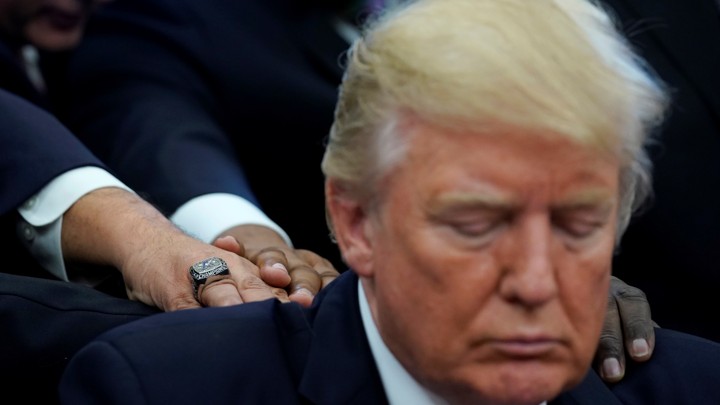
Why Some Christians ‘Love the Meanest Parts’ of Trump

Emma Green
The Atlantic
Originally posted August 18, 2019


Ben Howe is angry at evangelicals. As he describes it, he is angry that they didn’t just vote for Donald Trump in record numbers, but repeatedly provide moral cover for his outrageous failings. He is angry that leaders of the religious right, who long claimed to be the champions of American morality, appear to have gladly traded their values for power. He is angry that Christians claim they support the president because they want to end abortion or protect religious liberty, when supporting Trump suggests that what they really want is a champion who will mock and crush their perceived enemies.

To redeem themselves, Howe believes, evangelicals have to give up their take-no-prisoners culture war.

This is the story Howe, a writer and pundit, tells in his new book, The Immoral Majority—the title aptly riffs on the Moral Majority, the 1980s-era Christian political machine created by the influential pastor Jerry Falwell. Right-wing Christianity is Howe’s native territory: He grew up attending Falwell’s church in Virginia, Thomas Road Baptist Church, down the street from Liberty University, where Howe’s father, a Southern Baptist pastor, taught classes. In other years, Howe’s family attended First Baptist Church in Dallas, which is now pastored by one of Trump’s most vocal supporters, Robert Jeffress. After being raised in the bosom of the religious right, Howe went on to become a filmmaker, a Tea Party activist, and a blogger for the conservative website RedState, where he spent a not insignificant portion of his time trolling progressives. He was later fired from that website, along with other writers, because of his vocally anti-Trump views, he claims. (Rosie Gray wrote about the purge for The Atlantic in the spring of 2018.)

The interview is here.

Sunday, November 18, 2018

Dartmouth Allowed 3 Professors to Sexually Harass and Assault Students, Lawsuit Charges

Nell Gluckman
The Chronicle of Higher Education
Originally published November 15, 2018

Seven current and former students sued Dartmouth College on Thursday, saying it had failed to protect them from three psychology and brain-science professors who sexually harassed and assaulted them. In the lawsuit, filed in a federal court in New Hampshire, they say that when they and others reported horrific treatment, the college did nothing, allowing the professors’ behavior to continue until last spring, when one retired and the other two resigned.

The 72-page complaint, which seeks class-action status, describes an academic department where heavy drinking, misogyny, and sexual harassment were normalized. It says that the three professors — Todd F. Heatherton, William M. Kelley, and Paul J. Whalen — “leered at, groped, sexted,” and “intoxicated” students. One former student alleges she was raped by Kelley, and a current student alleges she was raped by Whalen. Dartmouth ended a Title IX investigation after the professors left, and, as far as the complainants could tell, did not attempt to examine how the abuse occurred or how it could be prevented it from happening again, according to the complaint.

In a written statement, a Dartmouth spokesman said that college officials “respectfully but strongly disagree with the characterizations of Dartmouth’s actions in the complaint and will respond through our own court filings.”

The info is here.

Saturday, December 9, 2017

The Root of All Cruelty

Paul Bloom
The New Yorker
Originally published November 20, 2017

Here are two excerpts:

Early psychological research on dehumanization looked at what made the Nazis different from the rest of us. But psychologists now talk about the ubiquity of dehumanization. Nick Haslam, at the University of Melbourne, and Steve Loughnan, at the University of Edinburgh, provide a list of examples, including some painfully mundane ones: “Outraged members of the public call sex offenders animals. Psychopaths treat victims merely as means to their vicious ends. The poor are mocked as libidinous dolts. Passersby look through homeless people as if they were transparent obstacles. Dementia sufferers are represented in the media as shuffling zombies.”

The thesis that viewing others as objects or animals enables our very worst conduct would seem to explain a great deal. Yet there’s reason to think that it’s almost the opposite of the truth.

(cut)

But “Virtuous Violence: Hurting and Killing to Create, Sustain, End, and Honor Social Relationships” (Cambridge), by the anthropologist Alan Fiske and the psychologist Tage Rai, argues that these standard accounts often have it backward. In many instances, violence is neither a cold-blooded solution to a problem nor a failure of inhibition; most of all, it doesn’t entail a blindness to moral considerations. On the contrary, morality is often a motivating force: “People are impelled to violence when they feel that to regulate certain social relationships, imposing suffering or death is necessary, natural, legitimate, desirable, condoned, admired, and ethically gratifying.” Obvious examples include suicide bombings, honor killings, and the torture of prisoners during war, but Fiske and Rai extend the list to gang fights and violence toward intimate partners. For Fiske and Rai, actions like these often reflect the desire to do the right thing, to exact just vengeance, or to teach someone a lesson. There’s a profound continuity between such acts and the punishments that—in the name of requital, deterrence, or discipline—the criminal-justice system lawfully imposes. Moral violence, whether reflected in legal sanctions, the killing of enemy soldiers in war, or punishing someone for an ethical transgression, is motivated by the recognition that its victim is a moral agent, someone fully human.

The article is here.

Sunday, July 27, 2014

Insufficient Punishment

By Keith Olbermann

Keith slams the National Football League for its tolerance for violence against women.  Keith also highlights larger cultural problems about demeaning women in American culture.